
Print on Demand for Beginners: 7 Products With Low Startup Costs
Print on demand for beginners means you sell a design on a product, a t-shirt, a mug, a poster, and a print partner makes and ships it only after a customer orders. You hold no stock and pay nothing until a sale happens. This guide covers seven products with low startup costs, the real fees on the main platforms, and the maths to check before you spend anything.
How print on demand works
You upload a design, a customer buys a product with that design on it, and a print partner prints it and ships it to the buyer. You never touch the product. What changes between routes is who brings the buyers and how much of each sale you keep.
There are two routes. A marketplace such as Redbubble, TeePublic, Spreadshirt or Amazon Merch on Demand brings buyers to you and pays you a fixed amount per sale, but you do not set the price. Your own store with a fulfilment partner such as Printful, Printify or Gelato lets you set the price and keep the difference after the base cost and shipping, but you bring the buyers yourself. Either route works. The wrong choice is paying a monthly plan before you know anyone wants the design.
Two rules apply on every platform. First, use only designs you made or have the right to sell: a logo, a cartoon character or a band name you do not own is the fastest way to lose an account. Second, check the print file rules before you upload. A low-resolution image prints badly, and a bad print earns refunds, not repeat buyers. If you already sell digital products online, the design skill carries over; the difference here is that a physical product has a base cost and shipping on every order.
Compare seven print-on-demand products
Start with the product whose ongoing work you can keep up with. A t-shirt needs new designs every week to stay visible. A poster needs a high-resolution file and far less upkeep. Pick the product whose work fits your week, not the one with the biggest headline margin.
Practical comparison, not a ranking of expected returns
| Product | Main upfront work | Work that continues |
|---|---|---|
| T-shirts | Design one print-ready file | New designs, listing upkeep |
| Hoodies | Design one print-ready file | New designs, seasonal updates |
| Mugs | Design one wraparound file | New designs, buyer questions |
| Posters and art prints | Prepare a high-resolution file | New artwork, size and framing options |
| Tote bags | Design one simple print | New designs, listing upkeep |
| Phone cases | Design one case file | New designs for new phone models |
| Stickers | Design small print-ready art | New designs, tagging |
Fees decide more than most beginners expect. A marketplace that pays $2 a sale can still be the better choice if it brings the buyers, while a store that keeps $8 a shirt earns nothing with no visitors. Compare the fee with the work involved, not with a guess at sales. Our list of online income ideas puts print on demand beside ten other options, with the same honest view of costs and risks.
Seven products to start print on demand for beginners
1. T-shirts
The t-shirt is where most beginners start, because it is the product buyers search for most and the blank is cheap. A plain tee with one clean design sells better than a busy design nobody can read at a glance. Start with one design in a few colours, not twenty designs in every colour.
On your own store, the numbers look like this. Printful lists the popular Bella+Canvas 3001 tee at about $11.95 in November 2026, with shipping from $4.95 for the first shirt in an order. Printify lists the same blank from $10.98, dropping to $8.77 on its Premium plan. Printful Growth costs $24.99 a month and takes up to 33% off product prices, becoming free once yearly sales pass $12,000. Printify’s Free vs Premium page lists Premium at $39 a month, or $299 a year, for up to 20% off the catalogue. Both platforms have a free plan, and that is where a beginner belongs. Prices vary by fulfilment location and change often, so read the live catalogue price before you set a retail price.
If you would rather not run a store, marketplaces pay a fixed amount per sale. Amazon Merch on Demand pays $2.44 on a $19.99 standard t-shirt at its default Creator tier, rising to $4.88 at Plus tier and $5.27 at Premium tier for sellers who bring more of their own traffic. Spreadshirt’s marketplace pays a flat $3.00 commission on a classic t-shirt. The trade is simple: no store to run, no price to set, and far less per sale.
2. Hoodies
A hoodie costs more to make and sells for more, so the margin per sale is bigger but the buyer expects better quality. A cheap-feeling hoodie earns a bad review faster than a cheap-feeling tee. Order a sample of the exact blank you plan to sell before you list it, and check the print, the weight and the fit yourself.
The Gildan 18500 pullover, a common starting blank, lists at about $21.95 on Printful and about $19.86 to $21.58 on Printify depending on the provider, with Gelato close behind at $21.59. Shipping is heavier too, from about $7.39 for the first hoodie. A hoodie priced at $39.99 leaves roughly $10 to $12 after the base cost and shipping on the free plans, before any store or payment fees. That is a workable margin, but only if the design is strong enough to sell at that price without a discount.
3. Mugs
A mug is a small, cheap product with one trap: shipping often costs as much as the mug itself. A buyer will not pay $12 to ship a $14 mug. Check the shipping cost for the product before you set the price, and be honest with yourself about whether the total still looks fair to a buyer.
An 11 oz white ceramic mug lists at about $6.50 on Printful, about $5.03 to $6.44 on Printify depending on the provider, and $6.26 on Gelato. On a marketplace the maths is different. Redbubble sets the base price and you set a markup, default 10%, on top of it. On an assumed $12 base mug at a 20% markup, your margin is $2.40, and a Standard-tier artist keeps half of that, $1.20, after Redbubble‘s 50% platform fee. TeePublic pays a flat $3.00 per standard mug at regular price for Artisan accounts, $2.00 during a sale. Mugs sell best as gifts, so a design tied to a hobby or an occasion beats a generic slogan.
4. Posters and art prints

Posters suit anyone who already makes art, photography or simple illustrations. The file matters more here than on a t-shirt: a poster is large, so a low-resolution file shows every flaw. Work at high resolution from the start, and test the print at the size you plan to sell.
An 18×24 inch matte poster lists at $13.75 on Printful, $8.37 on Printify and $9.09 on Gelato, while the smallest matte posters start from about $4.49 to $5.50. Gelato’s own overview notes its strength is local production close to the buyer, which keeps delivery times short for wall art. On TeePublic, art prints pay Artisan accounts $6 to $9 at regular price depending on size. A poster is also the product where a personal style matters most: buyers choose the art, not the blank, so original work is the whole advantage.
5. Tote bags
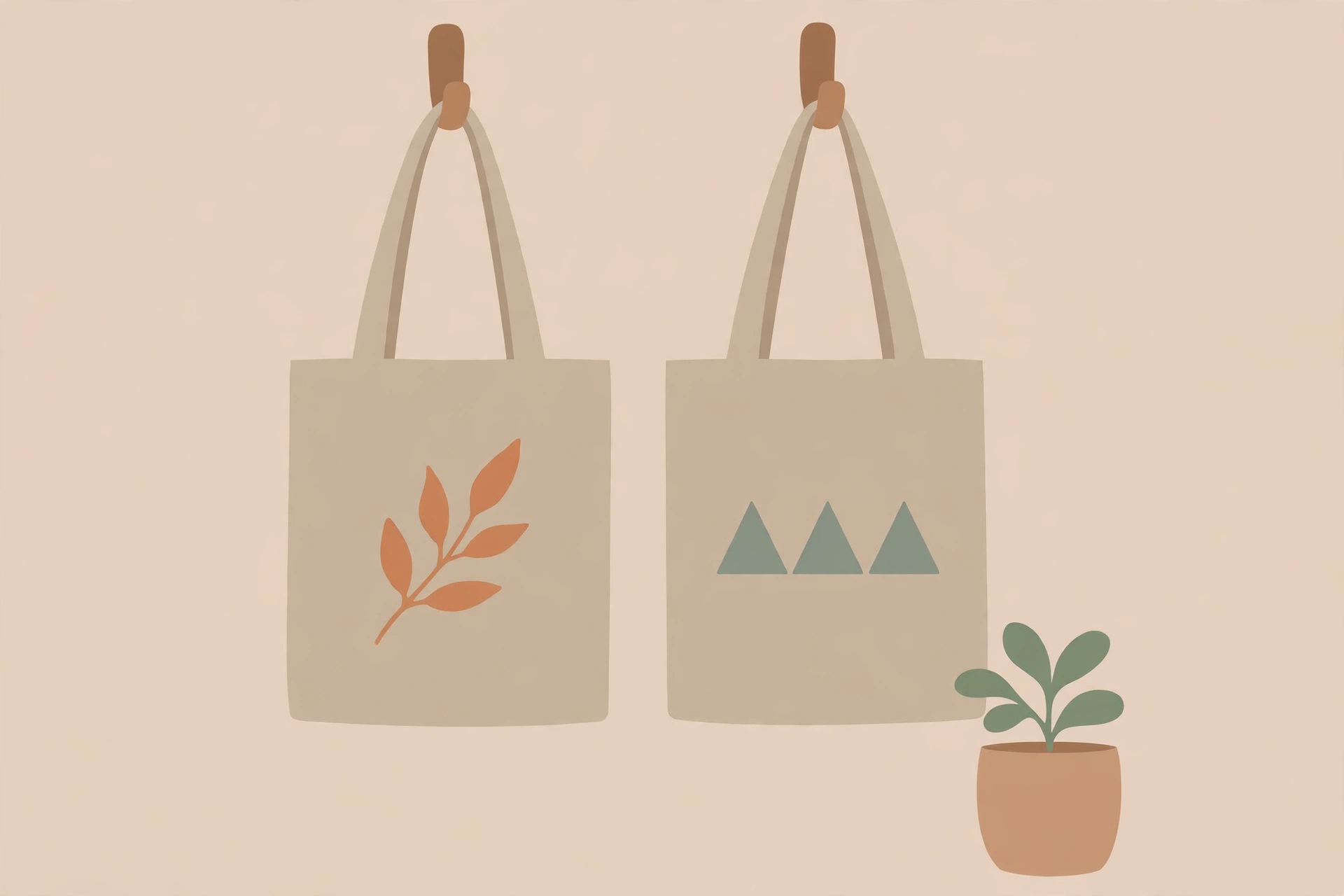
A tote bag is a simple product with a simple design rule: one clear print, easy to read from a few steps away. Detailed artwork gets lost on canvas. A short phrase, a simple drawing or a bold shape works better than a full illustration squeezed onto a bag.
A cotton canvas tote lists at $15.25 on Printful, $9.67 on Printify and $11.36 on Gelato. That spread is the widest of any product in this guide, so compare providers before you list. Totes sell well to buyers who already care about the design’s subject, a book club, a garden, a local joke, so a design aimed at one clear group beats a generic bag every time.
6. Phone cases

A phone case is a small, light product that ships cheaply, which is its main advantage. Its main drawback is churn: new phone models arrive every year, and a case for last year’s model stops selling. Check which models each provider supports before you spend an afternoon designing for one that is already fading.
An iPhone snap case lists at $16.95 on Printful, while an iPhone tough case lists at $11.22 on Printify. Gelato lists a slim case in its catalogue too, at a price that varies by model. On marketplaces, TeePublic pays Artisan accounts a flat $4.00 per phone case at regular price, $2.00 during a sale. Because the product changes so fast, treat phone cases as a side product for designs you already have, not the first product you build a shop around.
7. Stickers
Stickers are the cheapest product to start and the slowest to pay. One sticker earns cents, so this is a volume game: many designs, each earning a little, over a long time. That makes stickers a good first test of whether anyone likes your art at all, and a poor first product if you need money soon.
On Redbubble, a sticker with an assumed $3.00 base price at a 20% markup gives a $0.60 margin, and a Standard-tier artist keeps $0.30 of it after the 50% platform fee. TeePublic pays Artisan accounts $0.75 per sticker at regular price, $0.50 during a sale. Redbubble‘s fee rules matter here: Standard accounts pay 50% of monthly earnings, Premium accounts pay 20%, and Pro accounts pay nothing, with total fees capped at $150 per payment period. A separate 50% fee applies to earnings from any markup above 20%, so keeping your markup at or below 20% is the sensible default. Printful’s comparison page confirms the same tier and cap figures. Stickers reward a large catalogue, so upload often and tag each design with words a buyer would actually search for.
Check the numbers on a $25 t-shirt
Take a $25 t-shirt sold through your own store on Printful‘s free plan, using November 2026 catalogue figures. The base cost is $11.95 and shipping for the first shirt is $4.95, so the total cost is $16.90. You keep $8.10 before any store or payment fees.
The same order with two shirts looks better per shirt. Two shirts cost $23.90 in base cost, and shipping is $4.95 for the first plus $2.20 for the second, making $7.15. Total cost is $31.05 against $50 of revenue, so you keep $18.95, or $9.48 per shirt. Orders with more than one item are worth encouraging, because the second item ships far cheaper than the first.
Now add fixed costs. Suppose your design tool costs $30 a month. At $8.10 kept per single-shirt sale, four sales bring in $32.40, which just covers the $30. Five sales leave $10.50 above the tool. This is an illustrative example with assumed inputs, not a promise of what you will earn. Run the same sum with your own price, platform and costs before you decide what you can spend to find a customer.
Test a print-on-demand idea on a small scale
A planning example, not a deadline or an earnings promise
- Choose one product and one audience you understand. A tote bag for gardeners is a product. Merch for everyone is not.
- Make five to ten designs and list them on a free plan. Order a sample of the one you like best and check the print quality before you promote it. If you are still learning what customers pay for, a freelance project can teach you that before you build a shop.
- Set a limit on the time and money you will spend testing it. A free plan and a few evenings is a sensible first test. A paid plan and a month of evenings is not, until the idea has earned it. If you need a small budget for tools, short paid tasks such as get paid to test websites can cover a month of a basic tool.
- Track orders, returns, refunds and support hours. Ten sales with five returns is a different business from ten sales with none.
- Improve or stop the experiment based on what you observed. Discovering that nobody wants the proposed design is a useful first result. Finding that out before building a catalogue of two hundred designs is valuable too.
Frequently asked questions
How much money do I need to start print on demand?
Very little, if you pick a free plan. Printful, Printify and Gelato all let you start at $0 a month and pay only the base cost and shipping when an order comes in. Marketplaces such as Redbubble and TeePublic charge no monthly or listing fee at all. Your time is the real startup cost, and most people undercount it. A sample order of your own product is the one spend worth making, so you can check the quality before a stranger does.
Do I need my own store to sell print-on-demand products?
No. A marketplace lists your designs to its own buyers and handles printing, shipping and customer service. You earn less per sale and you do not set the price. Your own store gives you the price and the margin, but you bring the buyers yourself, which usually means a shop platform and some way to reach people. Start on a marketplace if you have no audience yet, and move to your own store once you know which designs sell.
Can I use designs made with AI tools?
Most platforms allow AI-made designs, but the rules differ and change, so read each platform’s current policy before you upload. The design must still be original: an AI image that copies a famous character, a logo or a living artist’s style can get your account closed just as fast as a copied file. Keep your prompts and source files, and do not claim a design is hand-drawn when it is not.
How long does it take to earn money from print on demand?
There is no honest timeline. A marketplace sale can come in the first week or after six months of uploading, and it depends on how many designs you have, how well they are tagged, and whether anyone is searching for them. Treat the first month as a test of whether your designs get found at all, not as a measure of what the business will pay.
The bottom line
Print on demand is real, cheap to start, and slow to pay. Pick one product that matches a design skill you already have, list it where its buyers already look, and check the base cost and shipping before you set the price. Give it a month of honest testing before you judge it. If it sells, you have a product worth improving. If it does not, you have lost a few evenings and learned why.
Sources and editorial notes
Fees and platform details were checked on 23 November 2026 against the linked platform pages and the November 2026 catalogue comparisons cited in the text: Printful‘s free plan at $0 and Growth at $24.99 a month with up to 33% off, Printify’s Free plan at $0 and Premium at $39 a month or $299 a year with up to 20% off, Gelato’s free plan at $0 and Gelato+ at $29.99 a month, Redbubble‘s Standard 50%, Premium 20% and Pro 0% platform fees with a $150 cap, TeePublic‘s flat Artisan royalties, Spreadshirt’s $3.00 marketplace commission, and Amazon Merch on Demand’s June 2026 Creator, Plus and Premium royalty tiers. Base product prices vary by provider and fulfilment location and change often; check the live catalogue price before you set a retail price. This article doesn’t report hands-on sales results. All images are AI-generated editorial illustrations created for Plioty. Read our editorial process or send a correction.